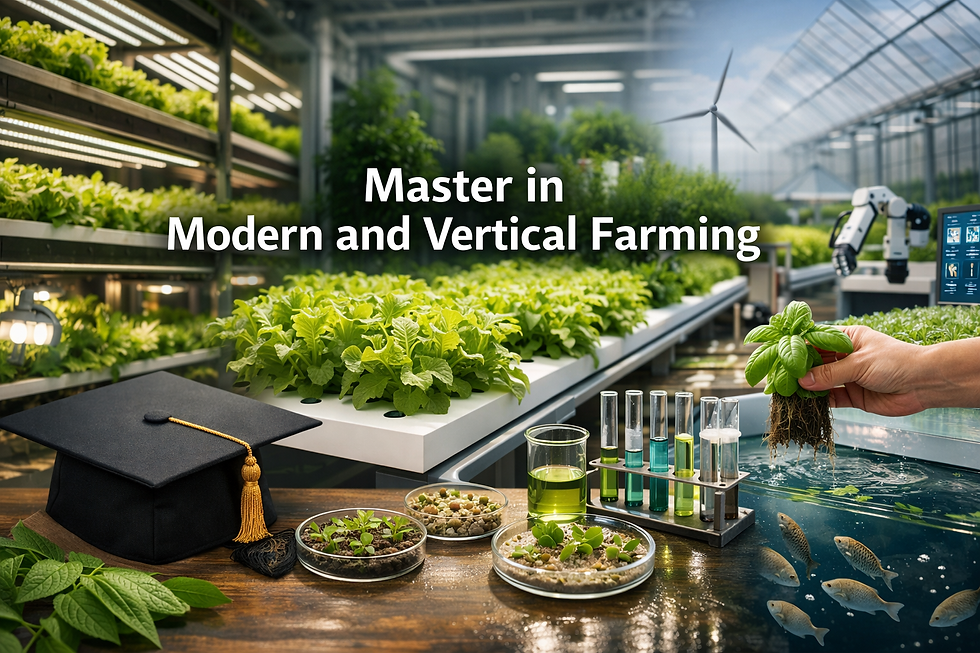
Master in Modern and Vertical Farming
- Feb 23
- 2 min read
This Master study program is an advanced, 100% research-based academic pathway designed for professionals and graduates who aim to lead innovation in sustainable agriculture, controlled-environment farming, and urban food production systems. Positioned at a study level equal to EQF Level 7 and aligned with the Second European Cycle, the program emphasizes scientific inquiry, technological integration, and applied research in modern and vertical farming systems.
With a total workload equivalent to 60 ECTS, the program is structured over a minimum duration of +12 months, offering flexibility for learners who may wish to extend their research period in accordance with their professional commitments or research depth.
The academic structure includes five modules, carefully designed to balance theoretical foundations and applied investigation:
Two research-related modules focusing on advanced research methodology, scientific analysis, data interpretation, and innovation design in agricultural systems.
Two general modules addressing sustainability frameworks, environmental policy, agri-business models, and strategic management in food production ecosystems.
One specialized module dedicated specifically to Modern and Vertical Farming, covering hydroponics, aeroponics, aquaponics, smart greenhouse systems, IoT integration, climate-controlled environments, resource efficiency, and food security strategies.
The program culminates in comprehensive thesis and research activities, enabling candidates to produce original research that contributes to the advancement of sustainable agriculture and high-efficiency urban farming systems.
This Master study program is ideal for agricultural engineers, environmental scientists, sustainability consultants, urban planners, agri-tech entrepreneurs, and policymakers seeking to transform food production models through technology-driven, climate-resilient solutions.
Graduates are equipped with advanced analytical skills, research competence, and strategic insight to contribute to food security, climate adaptation strategies, and next-generation farming innovations at local, regional, and global levels.